
How to Monitor Payment Transactions Securely Across Channels

Why monitoring payment transactions matters
Monitoring payment transactions is how you detect issues before customers feel them. When a payment card transaction fails, is delayed, or is processed twice, the operational cost starts immediately - support queues grow, reconciliation slips, and revenue reporting becomes unreliable.
A strong monitoring program gives you end-to-end visibility across authorization, capture, settlement, refunds, and disputes. It also helps you separate normal traffic variability from real incidents, such as routing failures with an acquiring bank or sudden declines from a PSP.
In practice, most teams combine multiple data sources - gateway logs, PSP/processor reports, acquiring bank statuses, fraud signals, and customer notifications - to build a consistent view of payment health. Without that consistency, “secure payment transactions” is only a slogan rather than an operational capability.
- Faster incident detection using actionable alerts
- Clear root-cause analysis across PSP, acquirer, and networks
- More accurate reconciliation for electronic payment transactions
- Lower fraud and chargeback impact through timely signals
Core signals to track across payment transactions
To monitor payment transactions effectively, you need metrics that describe both performance and correctness. Start with rates and timings: approval rate, decline rate, authorization time, capture latency, settlement timing, and refund latency. These metrics help you identify whether the problem is systemic (a partner outage) or localized (a single merchant integration or routing rule).
Next, track state transitions and exceptions. For each payment transactions flow - authorization → capture → settlement (and optional refund/dispute) - log the expected state changes and alert on missing or out-of-order events. This is especially important for secure payment transactions where idempotency and retry logic can otherwise create duplicates.
Finally, monitor customer-impacting communication. For example, mobile push payment transactions typically involve an app-side confirmation step, so you should measure “payment attempted vs. payment completed” from the user journey, not just server-side events.
| Signal | What it tells you | Common causes |
|---|---|---|
| Authorization latency | Where processing slows down | PSP routing issues, bank congestion, network delays |
| Capture lag | Whether funds are being captured reliably | Webhook delivery delays, job queue backlog, idempotency bugs |
| Settlement timing | When money moves to accounts | Partner settlement delays, batch processing changes |
| Refund latency | How fast customers get reversals | Refund API errors, insufficient authorization references |
| Duplicate detection | Prevents double charges and double captures | Retry without strict idempotency keys |
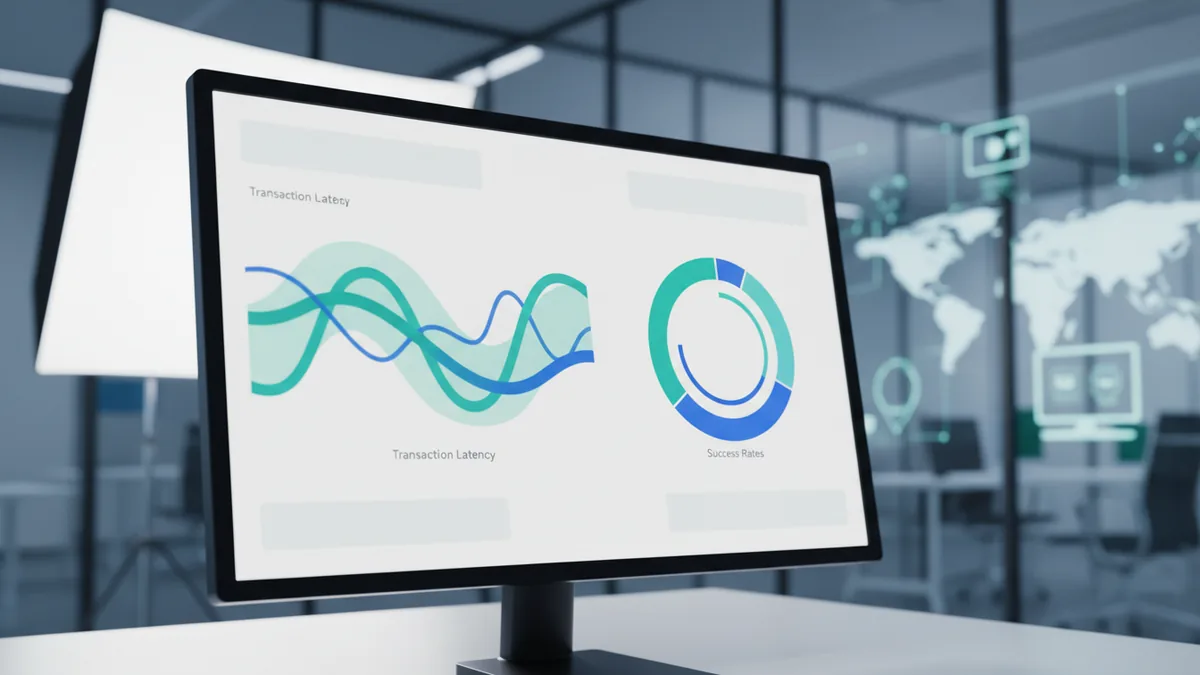
Monitoring across channels: cards, mobile, and electronic payments
Payment transactions don’t behave the same way across channels. Payment card transactions depend heavily on network authorization responses and issuer behavior, so your monitoring must capture decline reasons, AVS/CVC-related outcomes, and reason codes from the PSP. Treat these as first-class data: they drive both operational triage and product decisions.
Mobile payment transactions add a client dimension. You should instrument device and app-side state transitions, especially for wallet flows, deep links, and confirmations. When mobile push payment transactions are involved, track the end-to-end completion rate and the drop-off points between “push sent” and “payment completed.”
Electronic payment transactions via local methods or bank transfers often have different lifecycles and reconciliation rules. Monitoring should include method-specific states (e.g., pending, waiting for consumer action, confirmed) and partner-specific identifiers so your operations team can reconcile the payment without guesswork.
- Cards: prioritize authorization outcomes and decline reason code taxonomy
- Mobile: correlate app journey events with backend payment events
- Local/electronic methods: model method-specific states and reconciliation IDs
- All channels: keep a single payment timeline per transaction

Designing secure payment transaction monitoring and alerting
Monitoring secure payment transactions is not only about detecting failures; it’s also about controlling exposure. Treat logs as sensitive: mask card data, minimize storage of personally identifiable information, and apply strict retention policies. If you’re sending alerts to incident channels, ensure alert payloads do not include secrets, full PAN data, or unnecessary customer identifiers.
Build a layered alert strategy so you don’t drown in notifications. Use thresholds for performance (latency, timeouts, webhook delays) and for correctness (unexpected state transitions, missing events, duplicates). Then add “trend” alerts that detect sudden changes in approval or decline patterns rather than only absolute thresholds.
Finally, include escalation rules tied to ownership. If the issue likely originates with a PSP or acquiring bank, route alerts to the integration owner and capture partner incident IDs where available. For merchant-side problems, alert on integration-level changes such as webhook endpoint failures, signature verification errors, or idempotency key collisions.
- Set up canonical payment timeline events (authorize, capture, settle, refund, dispute)
- Define alert conditions for performance, correctness, and reconciliation gaps
- Mask sensitive fields and restrict log retention
- Route alerts by suspected layer (client, your backend, PSP, acquirer, network)
- Validate alerts against historical incidents and run tabletop drills
Operational workflow: triage, investigation, and resolution
Even the best monitoring fails without a practical workflow. Start with a playbook that answers: what alert fired, what it usually means, and which dashboards or logs to check first. Make it channel-specific - card issues often point to authorization declines, while mobile issues may involve confirmation or push delivery problems.
When triaging payment transactions, prioritize “who changed what” and “which partner is involved.” Compare the current failure rate to the baseline for that channel and region, and check deployment logs around the same time window. If only one integration or merchant account is affected, you likely have a configuration or routing issue rather than a partner outage.
During investigation, always validate whether you’re dealing with a reporting artifact or a real money movement issue. For example, a delayed webhook can create an apparent correctness failure even though the payment will settle successfully later. Confirm with partner settlement reports and reconcile by payment identifiers so your actions don’t create further risk.
| Triage question | Fast checks | Typical next action |
|---|---|---|
| Is it a specific payment method? | Filter by method, region, acquiring bank, PSP | Open partner investigation or rollback routing change |
| Is it latency or correctness? | Compare authorization vs capture vs webhook timing | Scale workers or fix webhook processing backlog |
| Are duplicates happening? | Check idempotency keys and retry logs | Disable retries temporarily and patch idempotency logic |
| Is reconciliation broken? | Compare internal records to settlement/export files | Re-run reconciliation and correct mapping tables |
Implementation checklist for end-to-end monitoring
If you’re starting fresh (or upgrading an existing system), use a checklist that covers data, instrumentation, and governance. Focus first on data modeling: define a single internal payment identifier and ensure all partners and channels map into that model. Then instrument event ingestion so you can detect missing state transitions in near real time.
Next, ensure observability covers the full lifecycle, including refunds and disputes - many teams only monitor initial authorization. For payment card transactions, also track chargeback and dispute statuses so you can connect monitoring signals to downstream financial outcomes.
Lastly, validate your monitoring under realistic conditions. Replay historical payment transactions (with sensitive fields masked) and test alert accuracy using past incidents. This reduces false positives and helps your team trust the monitoring before it matters.
- Canonical payment timeline with consistent identifiers
- Near real-time ingestion of PSP/processor statuses and webhooks
- Channel-specific dashboards (cards, mobile payment transactions, local methods)
- Idempotency and duplicate detection safeguards
- Secure logging practices and limited data retention
- Playbooks for triage and partner escalation
Frequently asked questions
What does monitoring payment transactions include end to end?
It covers the full lifecycle from authorization to capture, settlement, and also refunds and disputes. A good setup checks that expected state transitions happen and that reconciliation matches partner reporting.
How do I detect secure payment transactions that are stuck or incomplete?
Track timing thresholds for each lifecycle stage and alert on missing or out-of-order events. Correlate webhook delivery and partner status updates to distinguish delays from true failures.
Why do payment card transactions monitoring need decline reason tracking?
Decline reason codes explain whether the issue is issuer behavior, risk rules, or integration problems. Monitoring them helps reduce false alarms and speeds up troubleshooting and routing optimization.
How should I monitor mobile payment transactions compared to card payments?
Mobile flows need journey-level correlation between app-side events and backend payment events. For mobile push payment transactions, measure completion from push sent to payment confirmed and watch for drop-off points.
What are the most important signals for electronic payment transactions monitoring?
Use method-specific states and reconciliation identifiers, plus latency and exception tracking. Many electronic payment transactions require waiting periods and participant actions, so state modeling is crucial.
How can I prevent duplicates when monitoring payment transactions?
Enforce strict idempotency keys on your payment processing endpoints and detect duplicates from repeated event submissions. Alert on duplicate capture and inconsistent state transitions so you can pause retries safely.
Related Articles

Payment Ecommerce — Methods, Processing and Provider Choice
Compare payment methods, processing steps, provider costs, and checkout security.

Accept ACH Payments — Lower Fees and Easier Bank Transfers
Set up ACH payments, lower fees, and collect bank transfers with less friction.

School Fee Payments — Build a Better Online System
See how schools can make fee payments safer, faster, and easier.